Build worlds worth visiting
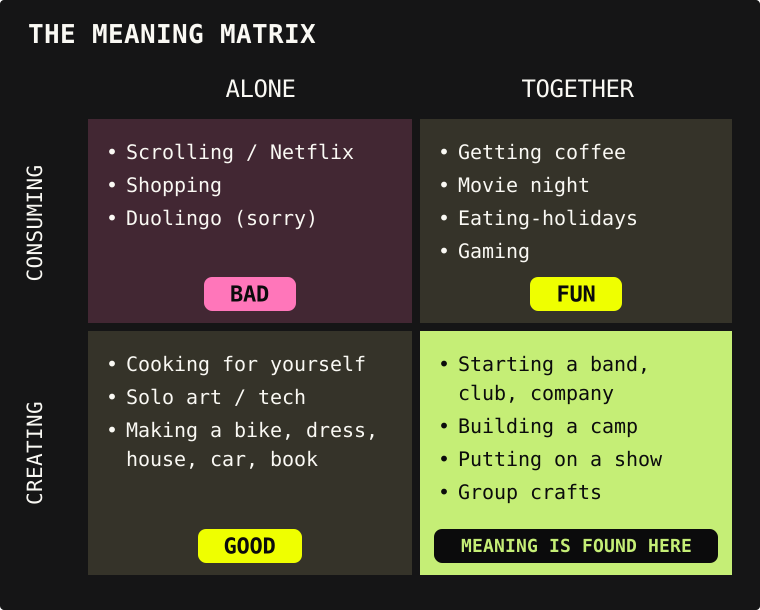
My colleague (and the brilliant) LB shared Ben James's article on aliveness with me - which is excellent and well worth a read - and his point about deliberately choosing to create things together got me thinking about what's happening in the software world right now.
With agents, we can build more of the things we've always wanted, exactly the way we want them. This is quite literally the most exciting time to be in software, and everyday is fulled with awesome glee building the stuff that previously you maybe only dreamt about.
But I can also see how easily we could disappear into our own little hidey-holes, building personal perfect worlds which nobody ever comes to visit...
Working with other people takes effort. You have to understand their thought-process, their code, explain your thinking, wait for feedback, and occasionally accept that your obviously brilliant idea doesn't actually work for anyone else (annoying yes, but reality!).
As building software becomes more and more a solo sport, avoiding all of that human friction becomes increasingly tempting. My concern is that we teach ourselves that building alone is the best way to build, and every time we avoid that friction and get exactly what we wanted, we reinforce it. Until we end up being the only users of our own amazing software.
I think we have a responsibility as software engineers to keep choosing to build together, whether that's within a company or an open-source project. And generating a huge pull request and leaving somebody else to make sense of it is a pretty generous definition of 'collaborating'.
There are bigger problems we could take on together. I'd like to see this new superpower go into more expressive programming languages and tools. Much of the code we write in mainstream languages forces us to break complex ideas down into low-level machinery, losing the abstraction we wanted to express in the first place.
More powerful abstractions have often come with a steep learning curve. Effect systems, dependent and linear types, typed DSLs, composable workflows - there is so much more available to us than the tools most teams use every day.
Agents can already work with these ideas and help us build with them. We can describe the problem, explore different ways to model it, and have an agent handle much of the unfamiliar syntax and plumbing. That changes the effort involved in adopting a more expressive approach. We still need to choose good abstractions and check that the software does what we intend, but far more teams can benefit from clearer models and much less boilerplate. That's a future worth building together.
Of course we should continue to build weird and wonderful and personal things too. Some of the most interesting ideas start with somebody's strange gutfeel that nobody else understands. But I'd like us to get into the habit of bringing what we learn back to other people, and inviting them into what we're building.
Article
  { slug: "build-worlds-worth-visiting"
  , originalUrl: Nothing
  , title: "Build worlds worth visiting"
  , date: constructDate 2026 10 28
  , keywords: ["open source","agents","collaboration","community"]
  , cover: { alt: "Code", caption: Nothing, src: "/images/covers/code.png" }
  , summary: "As building alone becomes easier, building together becomes a more deliberate choice."
  , author: { bio: "Towards an AI-first, hyper-scaled, functional reactive universe!", email: "tom@tomwells.org", name: "Tom Wells" }
  , body:
      [ FlowRichParagraph [ InlineText "My colleague (and the brilliant) LB shared Ben James's ", InlineLink { link: "https://benbyfax.substack.com/p/aliveness", title: "article on aliveness" }, InlineText " with me - which is excellent and well worth a read - and his point about deliberately choosing to create things together got me thinking about what's happening in the software world right now." ]
      , FlowParagraph "With agents, we can build more of the things we've always wanted, exactly the way we want them. This is quite literally the most exciting time to be in software, and everyday is fulled with awesome glee building the stuff that previously you maybe only dreamt about."
      , FlowParagraph "But I can also see how easily we could disappear into our own little hidey-holes, building personal perfect worlds which nobody ever comes to visit..."
      , FlowImage { alt: "Ben James's Meaning Matrix: consuming alone is bad, consuming together is fun, creating alone is good, and creating together is where meaning is found.", caption: (Just "The Meaning Matrix by Ben James, from Aliveness and where to find it (linked above and redrawn)."), src: "/images/articles/build-worlds-worth-visiting/meaning-matrix.svg" }
      , FlowParagraph "Working with other people takes effort. You have to understand their thought-process, their code, explain your thinking, wait for feedback, and occasionally accept that your obviously brilliant idea doesn't actually work for anyone else (annoying yes, but reality!)."
      , FlowParagraph "As building software becomes more and more a solo sport, avoiding all of that human friction becomes increasingly tempting. My concern is that we teach ourselves that building alone is the best way to build, and every time we avoid that friction and get exactly what we wanted, we reinforce it. Until we end up being the only users of our own amazing software."
      , FlowParagraph "I think we have a responsibility as software engineers to keep choosing to build together, whether that's within a company or an open-source project. And generating a huge pull request and leaving somebody else to make sense of it is a pretty generous definition of 'collaborating'."
      , FlowParagraph "There are bigger problems we could take on together. I'd like to see this new superpower go into more expressive programming languages and tools. Much of the code we write in mainstream languages forces us to break complex ideas down into low-level machinery, losing the abstraction we wanted to express in the first place."
      , FlowPullQuote "More powerful abstractions have often come with a steep learning curve. Effect systems, dependent and linear types, typed DSLs, composable workflows - there is so much more available to us than the tools most teams use every day."
      , FlowParagraph "Agents can already work with these ideas and help us build with them. We can describe the problem, explore different ways to model it, and have an agent handle much of the unfamiliar syntax and plumbing. That changes the effort involved in adopting a more expressive approach. We still need to choose good abstractions and check that the software does what we intend, but far more teams can benefit from clearer models and much less boilerplate. That's a future worth building together."
      , FlowParagraph "Of course we should continue to build weird and wonderful and personal things too. Some of the most interesting ideas start with somebody's strange gutfeel that nobody else understands. But I'd like us to get into the habit of bringing what we learn back to other people, and inviting them into what we're building."
      ]
  }